|
CRITICAL RESPONSE
AT THE PENNSYLVANIA GOVERNOR'S SCHOOL FOR THE ARTS
Mercyhurst
College
Erie,Pennsylvania
Sherry Knight and Wendy
Milne
|
|
|
|

|
A stereotypical reaction to criticism tends
to be negative, when in actuality the Proposed
Academic Standards for the Arts and Humanities
defines critical analysis, as "the process of
examining and discussing the effective uses of
specific aspects of a work of art."
In July 1999, students and faculty at the
Pennsylvania Governor's School for the Arts
actively participated in the process of critical
analysis. One approach was Liz Lerman 's six
step process for critical response. This
"artist-centered" approach encourages the artist
to be open when receiving comments about their
work of art and to move ahead in a more positive
way. Originally developed for dance, this
process has crossed over into the visual
arts.
|
|
|
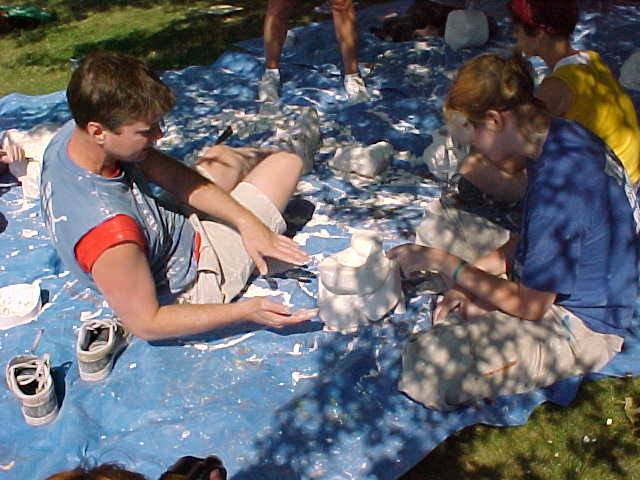
In this video clip, the student and
instructor analyzed and formed judgments about
her plaster reductive sculpture (Academic
Standards for the Arts and Humanities 9.3.12 A:
Analyze and synthesize the critical examination
processes of works in the arts and humanities
through comparing and contrasting, analyzing, interpreting, forming and testing hypotheses and
evaluating form judgments). Prior to the video
clip, the instructor, acting as responder, asked
the student's questions about her piece. Three of
Lerman's steps, Affirmation, Opinion Time and
Subject Matter Discussion, were discussed. Step
Two, Artist as Questioner, followed with
specific questions regarding suggestions for
continuation in the reduction process. (Once
people are well versed with the process of
critical response it is not always necessary to
follow the steps according to the order
suggested by Lerman.)
|
|
|
|
|
|
Liz Lerman's philosophy says
that this process excites the artist to go back
in and re-work the piece (Step Six: Working on
the work).
|
|
In the painting class, the instructor and the students engaged in
meaningful dialogue and critical response as depicted in the Proposed
Academic Standards 9.3.12:
A. Analyze and synthesize the critical examination processes of
works in the arts and humanities/ form and test hypotheses and
evaluate/form judgments.
B. Determine and apply criteria to a person's work and works of
others in the arts.
D. Evaluate works in the arts and humanities using complex and
advanced vocabulary and concepts of critical response.
E. Analyze the various types of critical analysis of works in the
arts and humanities/ intuitive criticism
F. Analyze works in the arts by referencing the judgments advanced
by arts critics as well as one's own analysis and critique.
G. Analyze and synthesize professional critical positions and
opinions about selected works in the arts and humanities.
(Art critic and professional critical positions are references to
the painting instructor, Terry Bowie.)
Step four- Opinion time, was the focus for the video clip shown
above. The five remaining steps of Lerman's model were addressed
sequentially during the critique.
This heartfelt response to the young artists who attended the
Pennsylvania Governor's School for the Arts exemphlies that the
stereotypical negativity in criticism need not occur to be
affective.