By
Mary G. Feasler-Soupart
and
Stanley J. Shaffer
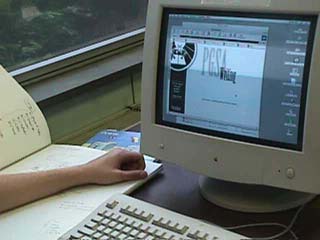
Standards Statement 9.3.12 A, B, C, D, E . Creating a Web Page for the Governor's School for the Arts in the Computer Art Technology Class.
"Analyze and synthesize the critical examination processes of designing a web page by determining and applying a system of classifying, interpreting, and forming a critical response in regards to one's own creative product; by evaluating one's own product employing complex, advanced vocabulary and concepts of critical response; and analyzing one's creative process incorporating critical analysis via contextual, formal and intuitive criticism."
Being enrolled in the Pennsylvania Governor's School for the Arts and designing the aforementioned web page in the computer art technology studio, Brian Lenhart, a visual artist, advanced critical response in five statement categories at the Grade 12 Advanced Level. Mr. Lenhart, utilizing the photo shop format, critically assessed his work demonstrating a sophisticated knowledge of the critical response format. (Lerman Model)
Standard Statement -9.3.12.A
"Analyze and synthesize the critical examination process of works in the humanities by using comparison and contrast strategies and by forming judgments."
On July 14, 1999, during the Theater Arts class at the Pennsylvania Governor's School for the Arts, the instructor engaged students in a variety of relaxation techniques and voice exercises. From the instructor s directives to his students, who sat on chairs in a circle on a lit stage along with their instructor, it was obvious these exercises had become a daily regime for all. The teacher briefly introduced the exercise, followed with a demonstration of the task. The students then followed their instructor's lead after each task.
During the vocal lesson unparticular, the instructor reminded the students to use their bodies, not merely their vocal chords, to produce sound.
The critical response noted in the exercise occurred when the instructor evaluated his/her students' performance en mass, employing comparison, contrast and determining judgments, as a formal critical venu, after several student choruses of "ahhh's" from his apt pupils, the teacher responded that indeed his class has improved in the last eight days of the exercise. He attested, at one point, "I am hearing a lot of good sound today."
Moreover, the instructor "formed a judgment" on the basis of his students' improvement with conscientious practice.
In sharing his judgment with his pupils, he validated their efforts by acknowledging their improvement. His critical response, in turn, motivated his students to continue their exercises with marked enthusiasm and continued improvement until closure of the exercise.
Therefore, through articulating a critical analysis of the class's improvement, the instructor intimated a performance model for his students to maintain in upcoming exercises so that they, in turn, evaluated themselves and one another during vocal exercises. Once students achieved a competency level that satisfied their instructor, they then knew what applied behavior and competency was expected of them. Through critical response students garnered the means by which to self-assess and to peer assess.
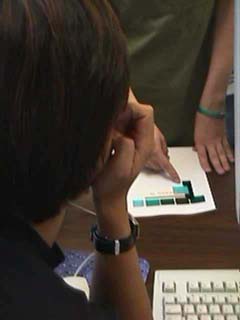
Standard Statement 9.3.12 A, B, C, D, E, F; Self- and Peer-Critical Analysis of Both a Computer Generated and Notebook Generated Collage.
"Analyze and synthesize the critical examination processes of one's own and of other's artistic product referencing applied criteria, developing interpretation and critical response, demonstrating advanced vocabulary, applying the tools of critical analysis including contextual, formal and intuitive criticism, and referencing the judgments of others, including those who are more knowledgable and experienced in the same venue.
Governor's School Computer Art Technology student artist Amy Vanhorn demonstrated a sophisticated understanding of critical analysis in evaluating her own graphic designs. Not only did she seek out the opinions and suggestions of her peers, she also engaged in the process of self-evaluation indicating an advanced level of critiquing. She viewed her own work in an honest fashion, engaging contextual, formal and intuitive criticisms. Miss Vanhorn was in the process of designing a collage accessing the capabilities of the computer program, but utilizing design ideas completed at an earlier time in her work book. Ms. Vanhorn kindly shared the process she used to get to the :"work in progress" on her computer desktop.
She noted in self-evaluation, displaying in her notebook an earlier collage, that her collage was rather simplistic and lacked sophistication. She also wanted to upscale her graphics to be less obvious and to contain more textual surface qualities. After critically analyzing her earlier work, which she had done at home before attending her class at the Governor's School, she then embarked on a new collage which contained her improvements. Her new design demonstrated the results of her careful critical evaluation, engaging multiple aspects of the critical response directive: she employed advanced vocabulary which she used in self-evaluation, which she willingly shared with the visitors of the Governor's Institute for Teachers in the Arts. By employing contextual, formal, and intuitive criticism, she was able to advance her level of creative results. Moreover, Ms. Vanhorn willingly sought the critical analysis of others in her class, whose feedback she also incorporated in her advanced product.
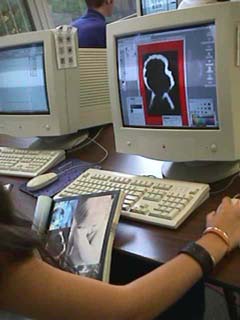
Art student Tara Rose compares her original idea source with her computer generated graphic in order to make any adjustments necessary. Through her observation and self- critiquing, Miss Rose demonstrates an aspect of critical analysis.
In the Computer Arts Technology Studio of the Pennsylvania Governor's School for the Arts, two visual arts students engage actively in a critical response situation brought about by Tara Rose inviting Gilbert Ho to comment on her graphic design, a poster for Mother's Against Drunk Driving (MADD).