Pennsylvania Governor's Institute
by Laura Ebersole and Kenneth I. Myers
|
|
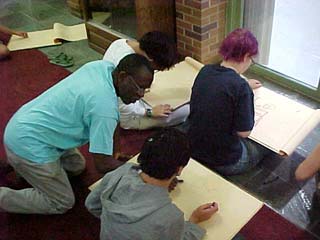
At the Pennsylvania Governor's School for the Arts, students can participate in a variety of artistic endeavors including art, music, theater and dance. Along with the various artistic pursuits, students are also taught to critique each others' work. The picture to the left is an example of one activity of learning that combines art with critical response. The students are sketching the movements of a dancer to study the composition of line in his/her movement. Students are analyzing and interpreting what they are seeing visually through this sketching process. This is an excellent example of achieving the proposed Academic Standard for the Arts and Humanities 9.3.A.12. One artist is also questioning the teacher about his/her ability to express the overall meaning or intent of the work from his/her perspective. The teacher helped his/her to develop a more detailed formal analysis by pointing out areas that may have needed more development. He/her also provided affirmation for work that was well defined. This process of viewer-centered analysis is another tool an artist can use to improve their artwork. |
|
To observe the process used, view this video clip.
At the Governor's Art Institute, students explore the genre of ceramics. Before critical analysis can be used, students must first create art using materials and processes like clay and the throwing wheel. During the creative process, students know the evaluation method that will be used to process a critical response before they begin to work. |
|
|
|
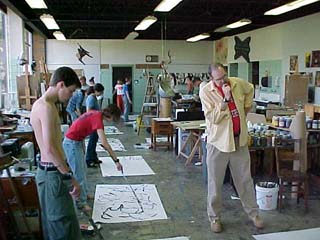
Line qualities and emotions behind different lines were the emphasis for this project in painting class. The students listened to various forms of music and then attempted to capture the emotional qualities of the musical pieces. The teacher guided students through the process by encouraging them to use both sides of the brush to express feelings toward the music and to circle around the paper to use the entire space available. The communication between the teacher and the student helps the artists to form a critical analysis of their work and practice the process of line strokes. Instructor Terry Bowie guided his students through the interpretation component of the Feldman Viewer-Centered model by asking his students to interpret emotional qualities of the music through their art form. The interpretation process also fulfills proposed Academic Standard 9.3.A.12 for the Arts and Humanities. |