The Criticism Process

by Elizabeth Bugbee and Barbara A. Cortese

Journals


The following presentation will display the investigative research of critical responses observed at the Governor's School for Excellence held at Mercyhurst College, July 1999. The Pennsylvania Standards for Arts and Humanities recognize the three types of critical analysis to be contextual, formal and intuitive criticism. Contextual criticism is a discussion and evaluation with consideration of the factors surrounding the origin and heritage to works in arts and humanities. Formal criticism is a discussion and evaluation of the elements and principles essential to works in the arts and humanities. Intuitive criticism is one's subjective insight to works in the arts and humanities. We observed students sculpting and painting in the studios. The students and the instructors were engaged in formal and intuitive criticisms.


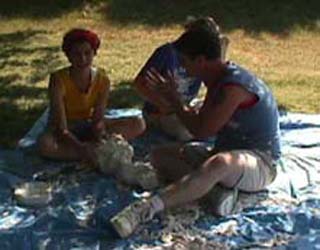
Prior to our visit , the students produced a basic form made by allowing plaster to harden in buckets, sketched their preliminary ideas and began carving their work. Upon our arrival the instructor asked the students to engage in a critical analysis of one of the works in progress. This correlates with Standard 9.3.10.A which states that the critical process can be achieved through comparison, analysis and interpretation. Critical response began with comments on the position of the figure. The crouched position gave one student the impression that the figure had a prehistoric look. Another student's response encouraged the young artist to focus on the intent of her work so it would capture what she was trying to convey. Suggestions made to accomplish this task were to work all around the figure, stand back and observe or possibly abstract the piece. The instructor 's criticism included a discussion with the student about the tools she used and the texture of the piece. He mentioned that she might give the figure the potential for movement by alternating rough and smooth texture in the figure to help move the observers eye along the figure.

A one-on-one dialogue between the instructor and another student followed. This discussion referenced standard 9.3.10.B in that it analyzed and interpreted specific characteristics of works in the arts within each art form. The instructor encouraged the student to consider the content of the piece. He/she stated that this could be accomplished by accenting one area with a rough surface texture or by turning it around to alter the way the viewer sees the piece. After further dialogue a consensus was reached to feel free to let the piece dictate how much to cut into it.
In the painting studio students were illustrating Jackson Pollack's technique using black paint and extra long handled brushes. Standard 9.3.10.G comparing and contrasting critical positions of opinions about selected works in the arts and humanities was demonstrated. After using Pollack's technique to create large compositions on the floor, students were instructed to use torn paper to block out selected lines to aesthetically improve the composition. One student engaged another in a discussion of his/her work. The ensuing dialogue dealt with the issues of the composition appearing too diagonal and a lot of white running through the whole piece. A solution to create some larger white spaces to contrast with the smaller white spaces was suggested.

Our observations showed how critical response as an ongoing process aided students in assessing their work. Students guided by the Academic Standards for the Arts and Humanities benefited from observing, thinking about and critiquing the work of themselves and others.